
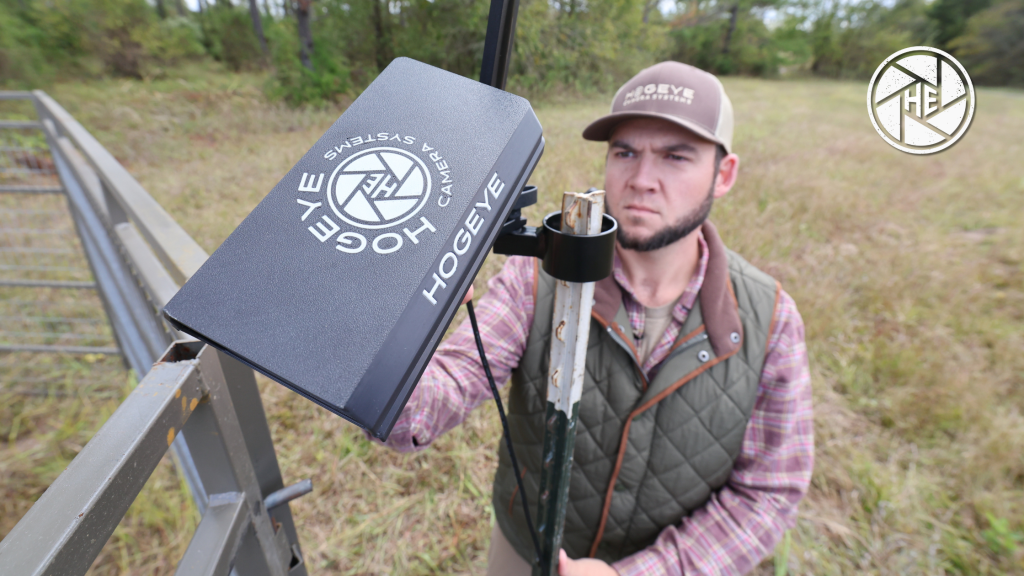
Don’t Let Mistakes with Off-Grid Cameras Cost You Coverage
Off-grid cameras can protect miles of ranch land — but only if they’re installed correctly.
Small errors during setup are the biggest reason systems lose power, drop signal, or fail when you need them most.
Here’s a checklist of the 10 most common installation mistakes and how to avoid them, based on real-world HogEye setups.
Learn more about the disadvantages and mistakes of DIY off-grid cameras.
1. Mounting Cameras Too Low
Low mounting gives hogs, livestock, or debris an easy chance to block or damage equipment.
Mount cameras at 6–8 feet high with a clear, unobstructed view of the monitoring zone.
Higher placement improves both range and solar exposure.
2. Ignoring the Sun’s Angle
Panels that face east or west lose up to 40% efficiency.
Always face solar panels true south and tilt them between 30° and 45° depending on latitude.
This setup maximizes energy capture and battery performance — a topic covered in more detail in Solar Power Myths in Ranch Security: What Really Works (and What Doesn’t).
3. Using Undersized Solar Panels
A 10-watt “trickle” panel can’t sustain 24/7 video or trap control.
Each HogEye system includes a high-output panel engineered to recharge its Group 29 or 31 deep-cycle battery daily.
Skimping on wattage is one of the fastest ways to end up with downtime.
4. Running Cables Too Long
Voltage loss increases dramatically past 10–12 feet.
Keep solar and camera cables as short as possible and use heavy-gauge wiring if extensions are required.
Seal all connections with dielectric grease or waterproof connectors to prevent corrosion.
5. Forgetting to Check LTE Signal Strength
Coverage can vary by a few yards, especially on uneven terrain.
Before final installation, test your LTE signal on a phone from each camera site. Aim for -100 dBm or stronger on your preferred carrier.
If the signal is weak, use HogEye’s external omni-directional antenna or mount higher for line-of-sight access.
See 5G Coverage in Rural America: What It Means for Cellular Camera Users for a carrier comparison.
6. Ignoring Shadows From Trees or Fences
Even partial shade can drop solar output dramatically.
Trim nearby branches and avoid mounting near tall fences or poles that cast midday shadows on panels.
Revisit the site once a season — sunlight angles shift throughout the year.
7. Overlooking Cable Security
Wildlife loves loose wiring.
Always zip-tie or conduit-cover all exposed cable runs, especially near the ground.
This prevents chewing and accidental unplugging from livestock or hog activity.
8. Not Testing Trigger Functions Before Leaving the Site
Always test trap, gate, or relay connections while you’re still on-site.
Open the HogEye Camera Management App, verify live video, and run a trigger test before you drive away.
This guarantees every relay port and camera connection is functioning before you rely on it remotely.
For more integration help, see Smart Ranching 2.0: How Cellular Cameras Integrate With Traps, Gates, and Feeders.
9. Skipping Monthly Maintenance
Dust and bird droppings can cut solar efficiency by 15–20%.
Wipe panels clean, inspect cables, and confirm camera firmware updates monthly.
Neglect is the quiet killer of every off-grid setup.
10. Forgetting About Battery Health
Batteries are the backbone of any off-grid system.
Check voltage levels quarterly, and replace deep-cycle batteries every 3–5 years.
Keep terminals clean and tight — corrosion causes voltage drops that lead to low power warnings.
For guidance on long-term costs and replacement planning, read The Complete Cost of Running an Off-Grid Camera System in 2026.
Pro Tip: Keep a Simple Installation Log for Off-Grid Cameras
Document your setup: panel angles, battery model, LTE strength, and connection dates.
That quick reference can save hours when troubleshooting power loss or connectivity later.
HogEye installers log every site detail to ensure maximum uptime — a habit worth copying.
Off-Grid Cameras Should Be Predictable, Not Painful to Run
Avoiding these 10 mistakes means more uptime, less frustration, and a longer lifespan for your entire security system.
If you’re ready to build your first setup or upgrade from consumer-grade cameras, start with proven solar and connectivity hardware from HogEye.