
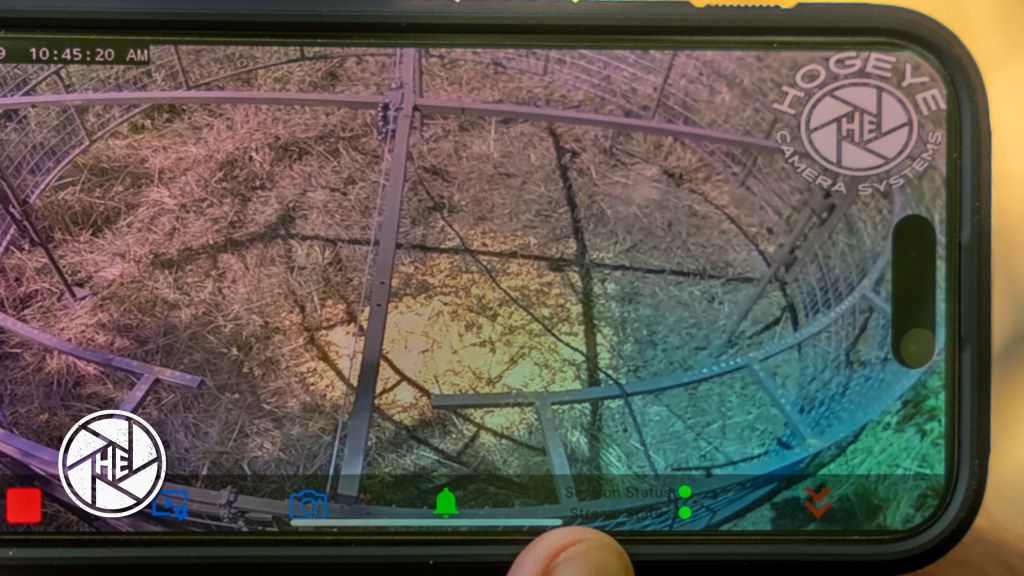
Real-Time Hog Video: How HogEye Prevents Missed Sounders
Across the South, ranchers have learned one lesson again and again: a missed sounder is the most expensive mistake in hog control. Whether you’re managing traps across thousands of acres or protecting a single property, real-time hog visibility—seeing hogs as they move, not minutes later—determines whether you capture 2 hogs… or 22.
Most low-cost off-grid cameras rely on photo alerts or delayed video clips. These can tell you that hogs were present, but not what’s happening right now, not how many hogs are inside a trap, and not whether you should trigger the trap at this exact moment.
HogEye was built to solve this problem entirely.
Rather than sending static images, HogEye streams true real-time video over LTE, giving ranchers full situational awareness and the confidence to trigger traps remotely with perfect timing.
This article breaks down what real-time video saves, what photo alerts miss, and why the difference is worth thousands of dollars per capture.
The Core Issue: Hogs Don’t Behave the Way Cameras Assume
Hogs enter traps cautiously and in waves. A sounder may:
- Send in a single scout
- Feed inside for minutes before committing
- Enter in staggered order
- Leave suddenly when startled
A photo alert tells you that motion happened. It does not tell you:
- How many hogs are inside
- Whether more hogs are incoming
- Whether the gate should close now or wait
- If the sounder became spooked and left
Real-time video solves every one of these problems.
Comparison Table: Real-Time Hog Monitoring vs Photo Alerts
Below is the exact difference between the two monitoring methods that ranchers experience in real ranch conditions.
| Feature | Photo Alerts (Reolink/Vosker/etc.) | HogEye Real-Time Video |
| Capture Timing | Delayed, unpredictable | Instant visual confirmation |
| Full-Sounder Verification | Impossible | Confirm full entry live |
| Trigger Decision | Guesswork | 100% informed |
| Night Monitoring | Grainy still images | High-quality live stream |
| Behavior Tracking | No | Yes—see pacing, feeding, hesitation |
| Multi-User Viewing | Rarely supported | Built-in access for teams |
| Reliability | Photo uploads may fail | Stream stays active with network shaping |
| Outcome | High risk of missed captures | Maximum capture efficiency |
This table alone explains why ranchers who try HogEye never return to photo-alert systems.
Why Real-Time Video Saves More Than Just Captures
The value of real-time video goes beyond dropping the gate at the right moment. It also prevents:
1. Lost Bait
Photo-based systems may alert after hogs have fed and left. That means wasted bait—sometimes hundreds of pounds per month.
2. False Triggers
Wind, raccoons, livestock, and lighting changes can all activate photo alerts. Without real-time verification, ranchers trigger traps too early or too late.
3. Fuel Costs
Without live visibility, ranchers drive to traps unnecessarily:
- To see if hogs were there
- To confirm if a trap fired
- To check whether the gate is still operational
Real-time video reduces these site visits by 70–80%.
4. Missed Full-Sounder Opportunities
This is the most expensive outcome. Every missed capture represents:
- More damage to land
- More depredation losses
- More nights wasted
- More feed consumed
A single missed sounder can cost thousands of dollars in damage and lost efficiency.
Real Ranch Example: The 17-Hog Miss
A rancher in Central Mississippi used a photo-alert system tied to a DIY control box. One night, motion triggered a photo at 11:07 PM. The image showed one hog inside.
He assumed the rest were coming.
What really happened:
- 12 hogs entered the trap by 11:14 PM
- 5 more circled outside but never entered
- The group spooked by 11:16 PM and ran
All of this happened before the next photo alert ever arrived.
With HogEye’s real-time video, the rancher would have:
- Seen all 12 hogs enter
- Waited to confirm no more were coming
- Triggered the trap at the perfect moment
The difference? 17 hogs lost in one night.
How HogEye’s Real-Time Streaming Works (And Why It’s So Reliable)
Most LTE cameras choke on video because they use:
- Consumer LTE chips
- Prepaid SIM cards
- No video compression controls
- No bandwidth shaping
HogEye’s system is engineered for live ranch conditions:
- Multi-carrier LTE redundancy
- Smart compression that adapts to signal strength
- Buffering that prevents stream dropouts
- Weather-sealed antennas
- Optimized modem firmware for continuous video
This is why HogEye streams reliably where cheap cameras fail.
When Real-Time Hog Monitoring Matters Most
Real-time video is essential for:
- Full-sounder trap control
- Remote ranch oversight
- Night captures
- Monitoring multiple traps
- Training new trappers
- Reducing ranch travel and fuel costs
- Coordinating teams
If precise timing matters, real-time video isn’t a luxury—it’s a requirement.
Conclusion: Real-Time Hog Video Monitoring Pays for Itself
A trap camera shouldn’t just tell you that hogs were present—it should show you what’s happening right now.
Photo alerts miss motion, delay information, and force ranchers to guess. HogEye removes every uncertainty by giving full visibility in real time.
The result?
- Fewer missed sounders
- Fewer wasted trips
- Fewer false triggers
- More efficient trapping
- More hogs captured
Real-time video doesn’t just improve outcomes—it transforms ranch operations.
Upgrade to Real-Time Hog Monitoring Before You Miss Another Sounder
If you’re using photo-alert cameras—or if you want to improve your capture timing—our team can show you how real-time video changes everything.
Talk to HogEye: https://hogeyecameras.com/buy-now/
Camera Resources: https://hogeyecameras.com/camera-resources/
Hog Traps: https://hogeyecameras.com/hog-traps/