
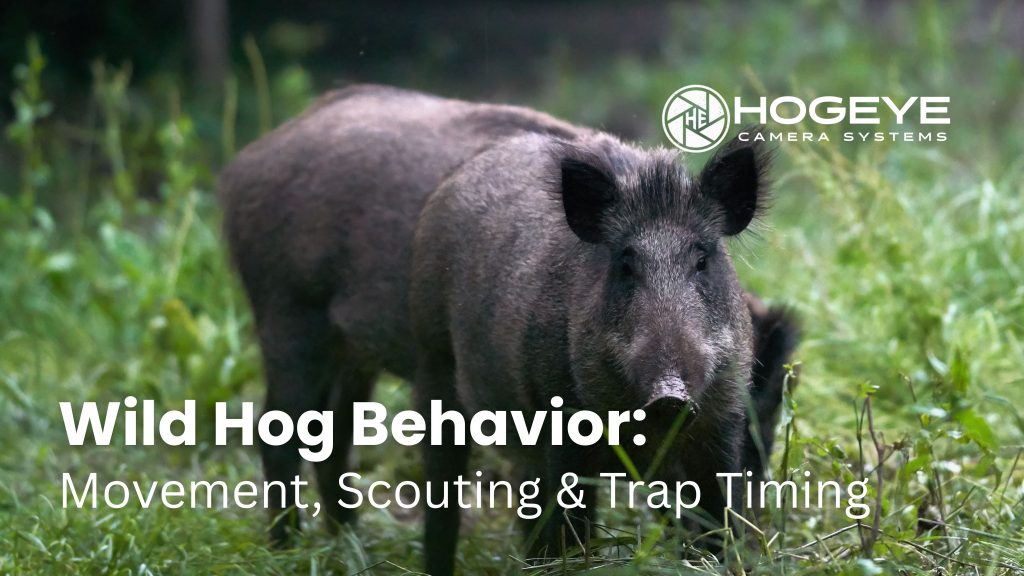
Wild hog behavior is not random. Feral hogs follow patterns, and once you understand wild hog behavior, you stop guessing and start catching.
Most trap failures come down to timing. The operator shows up to close the gate on their schedule, not the sounder’s. The bait gets hit but the whole group isn’t in. Someone triggers too early, catches three pigs, and educates the rest. Understanding wild hog behavior is what separates a productive trap program from a frustrating one.
Table of Contents (wild hog behavior)
There’s a secondary cost that doesn’t get discussed enough: passive traps (traps left open and unmonitored) can misfire, catch part of the sounder, and release the survivors. Those survivors are now trap-shy. They’ve associated the structure with danger. They breed, and the next generation carries that wariness. A poorly timed trigger doesn’t just miss the event; it can set back a property’s trapping program by months.
This is not a hunting guide. This is a trap management guide built around how hogs actually behave in the field.
Are Wild Hogs Nocturnal? (wild hog behavior)
The short answer: it depends on pressure.
In areas with active hunting, regular human disturbance, or previous trapping activity, wild hog behavior shifts almost entirely to nocturnal movement. They learn fast. A sounder that gets bumped at a bait site once will often avoid that location in daylight for weeks.
In low-pressure areas (remote agricultural land, thick timber with limited access) hogs will move morning and evening and sometimes midday. But apply consistent human presence, and the behavior shifts toward darkness within a few weeks.
Temperature drives it too. In summer across the South, hogs are almost exclusively nocturnal because thermal load during the day forces them into wallows and shade. You will not see meaningful movement between 9 AM and 7 PM in July. In cooler months, that window opens. In a cold snap in January, you may see hogs moving mid-morning.
What this means for trap operators: “check the trap at dawn” is often wrong. If you are operating in a pressured area during warm months, the action is happening between 10 PM and 3 AM. A dawn check tells you the result; it does not give you the ability to act on it. Real-time remote trap monitoring lets you see what is happening when it is happening, not six hours later.
Adjust your expectations around the actual activity window in your area and season. Do not assume hogs are on your schedule.
How Wild Hogs Scout a New Area (wild hog behavior)
Hogs do not walk into a new bait site on night one. This is one of the most consistent wild hog behavior patterns operators misunderstand, and it causes early triggers that ruin the program.
When you put out bait, the sequence typically looks like this:
Night 1–2: No contact, or a single hog passing through the edge of the area. The smell is there but there is no commitment.
Night 3–5: A mature sow approaches the site. She circles it. She may eat a small amount of bait from the perimeter, then leave. She is not eating; she is evaluating. This is the sow-leads pattern. In a stable sounder, the dominant sow is the decision-maker. She scouts before the sounder commits.
Night 5–8: The sounder makes its first full approach. In some cases, they come in together. In others, they stage nearby while the sow feeds first.
Night 8–10: If nothing has spooked them, you have full conditioning: the sounder is entering the site with regularity, and you have a reliable closure window.
Camera footage reviewed as part of HogEye’s behavior data and capture optimization research confirms this timeline across multiple properties. The 72 hours before a successful catch almost always show a clear escalation: perimeter approaches become full entries, hesitation gives way to confident feeding, and the sounder’s arrival time becomes predictable within a 30–45 minute window.
Do not trigger before that window is established and you know the complete sounder is in the trap. Use your camera footage from the pre-baiting phase to establish a baseline sounder count: how many animals are in the group, and which ones are consistently arriving. Monitor across multiple nights to confirm that count before you consider triggering. Catching the lead sow alone or taking a partial sounder early costs you the program.
Understanding the Sounder: Structure, Hierarchy, and Why It Matters for Trapping
What is a sounder?
A sounder is the social unit of feral hogs (typically one or more mature sows, their juvenile offspring from the current and prior season, and subadult females). The name comes from the sound a group of pigs makes when moving through brush. A typical sounder runs 4 to 12 animals, though sounders of 20 or more are documented in areas with low removal pressure.
How many pigs make a sounder?
There is no fixed number. Two sows and their piglets from two litters can form a functional sounder of 10–14 animals. High-density populations with intact social structures can run larger. The key unit is the matriarchal group: sows, subadults, and juveniles.
Adult boars are largely solitary outside of breeding season. They associate with sounders during the rut but do not travel with them year-round. If you are seeing lone pigs hitting your bait site, you are often looking at a peripheral boar; and catching him does not address the sounder.
Why does sounder structure matter for trapping?
Because whole-sounder removal is the only approach that produces lasting results. Catch a few juveniles and release pressure, and the remaining animals (including breeding-age sows) repopulate the area within months. Corral-style traps like the Big Pig Trap are designed for this: large enough to hold a full sounder, with a gate or trap that closes on the group, not on whatever animal happens to enter first.
Waiting for the whole sounder to commit before triggering is not patience for its own sake. It is the only math that works.
Seasonal Behavior Changes
Wild hog behavior is consistent in its structure but variable in its timing. Season changes the when, not the what.
Spring (March–May)
Breeding activity increases boar movement significantly. Boars that have been solitary all winter begin ranging more widely, following estrus sows. You will see more random single-pig contacts at bait sites during this period. Do not mistake boar activity for sounder presence. Focus on identifying the sow-led group and conditioning them separately.
Summer (June–August)
Nocturnal concentration is at its peak. Hogs cluster around water (creek bottoms, stock tanks, wet drainages). Wallows are active and fresh. Bait sites near water will out-produce sites away from it significantly during this window. If your property has no natural water source near the intended trap site, create one: haul buckets of water to the location and build a mud hole. Hogs will use it, and it becomes a secondary draw that anchors them to the site. Set your expectations: you are fishing with a narrow nighttime window, and the hogs will not deviate from it.
Fall (September–November)
Mast crop availability reshapes hog range. When acorns drop, hogs shift their core area toward timber. A bait site that was productive in August may go cold in October, not because the hogs left the property, but because the groceries moved. Scout your mast sources and reposition bait sites accordingly.
Winter (December–February)
In cold climates, daytime activity increases as hogs need to feed more frequently to maintain body temperature. This is often the most productive trapping window in northern states because movement windows are wider and more predictable. In the deep South, winter behavior is more moderate but still more flexible than summer.
Adjust your monitoring intensity to match the season. Smart trap systems that log approach data let you track activity shifts without physically checking sites and burning the location.
Reading Sign: How to Know Hogs Are in Your Area
Before you set a trap, confirm presence and understand where hogs are moving. Camera data is the most reliable method; physical sign tells you where to put the camera.
Rooting
Fresh rooting is the clearest indicator of recent activity. Fresh rooting is moist underneath (turned soil that has not dried out or crusted over). Old rooting is dry, grass is starting to grow back into the disturbed area. Fresh rooting within 24–48 hours means hogs are in the immediate area. Wild hog rooting is distinct from deer or raccoon disturbance: the scale is larger, the soil is more completely turned, and it often covers significant area (10–50 square feet or more from a single feeding session).
Wallows
Active wallows have fresh mud on the banks and, in warm months, may show daily use. Wallows are often located near water sources and are used repeatedly by the same sounder. A wallow within 200–300 yards of a potential bait site is a strong indicator that hogs are patterning through that area.
Tracks and trail corridors
Feral hog tracks are round-toed, heavier in the heel than deer, and typically show dewclaws in soft mud. Look for repetitive trails through fence crossings, creek bottoms, and field edges. These corridors are where hogs travel consistently; bait sites positioned near a confirmed travel corridor condition faster than sites placed in open ground.
Rubs
Hogs rub fence posts, gate posts, and trees after wallowing (depositing mud and oil from their skin). Active rubs are dark and wet. They are often located near wallows on the travel corridor out of the wallow site. Rub posts confirm regular movement through a specific location.
Use this sign to identify your bait site location before you invest in conditioning time. The HogEye camera resources library covers site selection and camera placement in detail.
How Behavior Should Drive Your Trap Strategy
Everything above, the scouting pattern, the sounder hierarchy, and the seasonal windows, should directly inform how you run your trap program.
The conditioning window is not optional.
Budget 5–10 nights minimum before you consider triggering. In pressured areas or with a large, cautious sounder, 14 nights is not unusual. The bait conditioning period is when hogs move from suspicious to habituated. Trigger before that point and you catch a partial sounder at best, and you educate the remainder at worst.
A critical part of maintaining that conditioning window: check your bait site daily via camera and keep the corn refreshed. If the sounder arrives to an empty bait site two nights in a row, they’ll shift their pattern… Consistent bait availability is what keeps the sounder returning on a predictable schedule, and predictability is what makes the closure window possible.
A fixed check schedule fails.
Checking the trap every Tuesday and Friday morning does not align with wild hog behavior. Hogs do not wait for your schedule. If the sounder commits on a Wednesday at 11 PM and you do not know it until Friday at 6 AM, you have missed your closure window; and depending on the trap type, you may have lost them if the gate was open.
The case for real-time monitoring
The closure window (the moment when the full sounder is inside the trap and committed) may last 20 minutes. It may happen at 1 AM. Without live visibility, you cannot act on it.
A wild hog trap camera system like HogEye gives you live video and motion alerts when the sounder enters. You see the animals, count them against your baseline camera footage, confirm the full group is in, and trigger remotely. You do not need to be on-site. You do not need to wait for daylight. The full net trap monitoring workflow walks through exactly how this works in practice.
This is the difference between a trap program built around wild hog behavior and one built around operator convenience. One of them consistently catches more hogs.
Frequently Asked Questions
What time of day are wild boars most active?
In pressured areas, wild hogs are most active between 10 PM and 3 AM. In low-pressure areas or cold weather, activity can extend into early morning and late afternoon. Temperature is a significant driver: summer heat pushes hogs almost exclusively nocturnal, while cool fall and winter conditions expand the activity window.
Do wild pigs sleep at night?
Not in the way the question implies. Wild pigs are not nocturnal by nature; they are adaptable. In undisturbed conditions, they may be active at any hour. In areas with hunting or trapping pressure, they shift activity to nighttime hours as a learned avoidance response. They do rest during the day, typically bedded in heavy cover, but their primary feeding activity in pressured environments happens at night.
How many pigs make a sounder?
A functional sounder typically ranges from 4 to 12 animals, centered on one or more mature sows and their offspring. Sounders of 20 or more occur in areas with low removal pressure and high forage availability. Adult boars are not typically part of the sounder except during breeding season.
Why are pigs called sounders?
The term “sounder” comes from the Old English and Old French words for a group of swine (specifically tied to the sound a group of pigs makes when moving). The term has been in use for centuries and refers specifically to a group of wild or feral swine traveling together as a social unit.
What are signs of wild hog activity on my property?
The most reliable signs are fresh rooting (moist, recently turned soil), active wallows (wet mud, visible hoof impressions), repetitive tracks along fence lines and creek crossings, and rub marks on fence posts or trees near wallow sites. Trail corridors (worn paths through fence gaps or along field edges) indicate regular movement patterns worth targeting with a bait site.
Ready to run a trap program built around how hogs actually behave?
HogEye gives you live visibility into your trap sites, real-time alerts when the sounder commits, and remote trap monitoring from your phone, so you close the right window, not the next available one.
Talk with the HogEye team about your operation →