
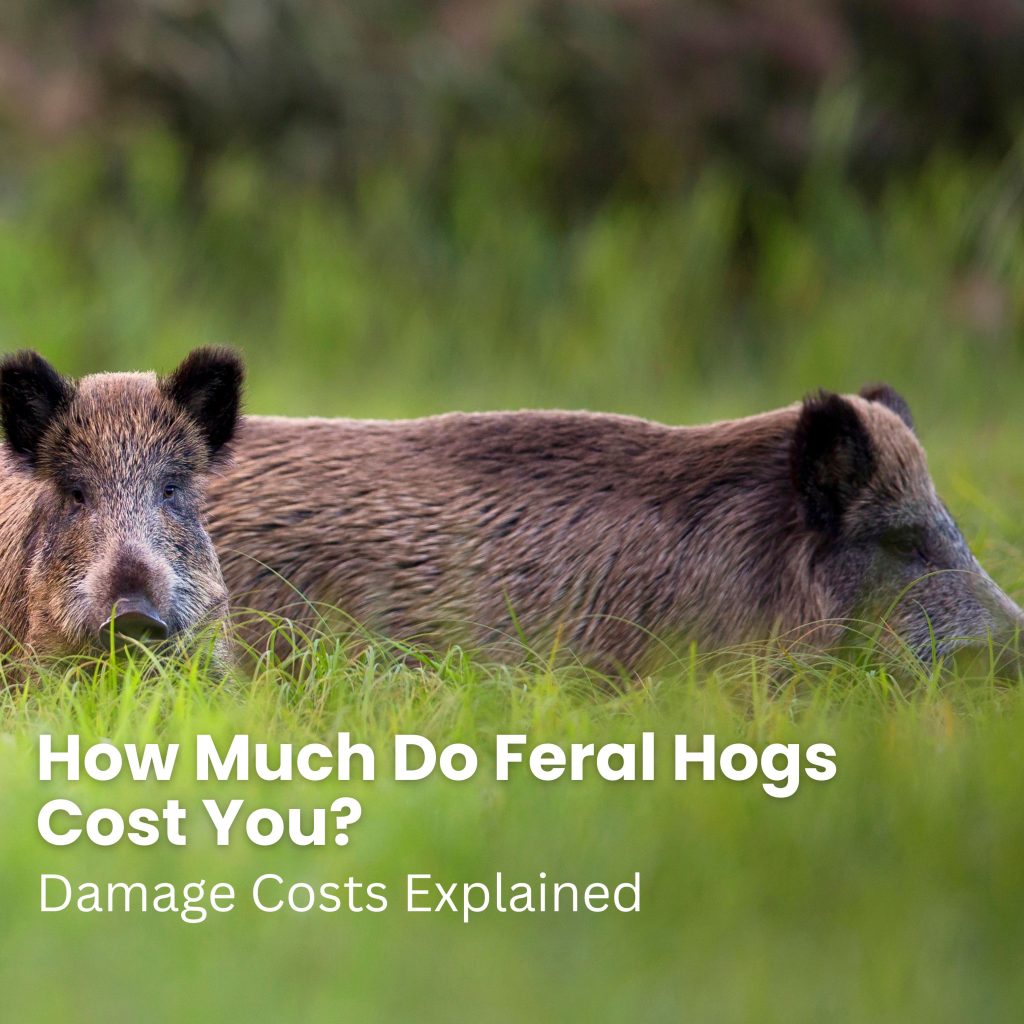
Most landowners underestimate feral hog damage until they do the math. A sounder working your property isn’t just tearing up ground; it’s compounding losses every night it stays there. The question isn’t whether feral hogs are costing you money. It’s how much, and whether your control program is actually keeping pace.
USDA estimates feral hogs cause more than $2.5 billion in agricultural and ecological damage annually across the United States. That national figure is useful context, but it doesn’t tell you what’s happening on your 500 acres in East Texas or your row crop operation in Georgia. The number that matters is the one tied to your sounder, your crop, and your control costs.
Table of Contents
This article breaks feral hog damage down by crop type, property size, and herd composition, so you can put a real number on what you’re dealing with and make a better-informed decision about your hog trapping program.
The National Picture: $2.5 Billion and Growing
The $2.5 billion figure comes from USDA APHIS and has been widely cited by Texas A&M AgriLife Extension and other state programs. It covers direct agricultural losses (destroyed crops, damaged fencing, ruined irrigation infrastructure) as well as ecological damage including wetland degradation, erosion, and destruction of native plant communities.
What it doesn’t capture is the full picture. Property damage to equipment, vehicle damage from holes and ruts in fields and roads, and the cost of failed control attempts are rarely included in formal damage estimates. Real-world losses run higher.
Three things are driving the number up year over year:
- Population expansion. The feral hog population in the US is estimated between 6 and 9 million animals, with established populations in at least 35 states. The range continues to expand northward as winters warm.
- Reproduction rate. A sow can produce two litters per year, averaging 4–6 piglets per litter. A single sounder left unmanaged can become multiple sounders within two breeding seasons.
- Behavioral adaptability. Hogs that experience trapping pressure become more nocturnal and more cautious. Reactive control methods (shooting, snaring) move the problem without solving it. Hog behavior data consistently shows that pressure-adapted sounders are harder to recondition to a new trap site. The damage continues.
If you’re managing a property with active hog pressure and your control program isn’t removing whole sounders consistently, your losses compound each season.
What Feral Hog Damage Actually Looks Like
Understanding feral hog damage is the first step toward quantifying it. Feral hogs cause harm in three distinct ways, and each has a different cost profile.
Rooting is the most common and most visible. Hogs use their snouts to turn soil in search of roots, tubers, grubs, and earthworms. A sounder of 10–15 animals can root several acres of pasture or crop ground in a single night, leaving the surface looking like it was tilled by a machine (except uneven, compacted in some areas, and impossible to mechanically repair without full rework).
Fresh rooting is dark, disturbed soil with loose clods and visible snout marks. Old rooting dries and crusts over, leaving irregular mounds and depressions that persist through the growing season.
Wallowing occurs near water sources, creek banks, pond edges, and irrigation ditches. Hogs roll in wet mud to regulate temperature and remove parasites. Repeated wallowing at a single site erodes banks, destabilizes water features, and introduces fecal contamination into water supplies used by livestock.
Crop raiding causes concentrated, high-value losses. Hogs enter a stand of corn, soybeans, or grain sorghum and consume or trample far more than they eat. A large sounder in a mature corn field isn’t grazing; it’s destroying. The net hog trap workflow exists precisely because corral traps and soft net systems like the Boar Blanket are often the only options that can intercept a whole sounder in an active feeding area.
Feral Hog Damage Cost by Crop Type
The table below reflects field-reported and extension-documented loss ranges. Actual losses vary by sounder size, visit frequency, and crop maturity at time of damage.
| Crop | Typical loss per acre (active sounder) | Notes |
|---|---|---|
| Corn (mature) | $150–$400/acre | High-value target; a single night event can destroy a stand |
| Soybeans | $80–$200/acre | Rooting damage plus pod consumption; worst near field edges |
| Wheat / small grains | $50–$150/acre | Rooting disrupts root zones; damage compounds through season |
| Improved pasture | $100–$300/acre | Rooting destroys stand; reseeding + herbicide adds to cost |
| Native pasture | $30–$80/acre | Slower to recover; erosion risk in rooted areas |
| Vegetable / specialty crops | $500–$2,000+/acre | Concentrated high-value losses; catastrophic in small operations |
| Orchards / nursery stock | Variable | Rooting around root zones; irreversible tree damage possible |
Fencing and infrastructure adds a separate cost category that most damage estimates undercount. A single hog crossing (repeated nightly) collapses wire fencing, bends posts, and creates gaps that require full section replacement. Field-reported repair costs run $400–$1,500 per section depending on fence type, with high-tensile and barbed wire in the $700–$1,200 range per 100-foot section.
Irrigation infrastructure damage (collapsed underground lines, rooted-out drip tape, damage d valve boxes) is less predictable but can exceed crop losses in some operations. A thorough hog trap gear audit helps operators account for these hidden costs when evaluating program ROI.
How Sounder Size Changes the Feral Hog Damage Math
A single hog on your property is an inconvenience; a sounder of 15 is an operational threat. The relationship between herd size and damage isn’t linear: it’s multiplicative.
A sounder of 5 animals covering a regular circuit might damage 2–3 acres per week during active feeding. A sounder of 20 animals working the same route damages 8–12 acres per week, but they’re also accelerating soil compaction, widening rooting corridors, and establishing bait-site patterns that attract new animals.
That distinction matters for your control program. Catching one or two hogs from a sounder of 15 doesn’t solve the problem; it alerts the remaining animals to the trap site, makes them more cautious, and leaves 13 animals on your property. The damage continues. The sounder reorganizes.
Effective damage control requires catching the whole sounder in a single event, or close to it. That’s not a trap hardware problem. It’s a timing and monitoring problem, the same constraint smart hog trap systems are built around: knowing when the full sounder is committed to the trap site, and closing at the right moment.
The cost of getting that wrong compounds quickly. A partial catch that pressures the sounder sends them to a new circuit. Now you’re running a new bait site, a new conditioning cycle, and absorbing another 6–8 weeks of damage while you get them patterned again.
What Landowners Are Actually Spending on Control
Control costs are rarely factored into damage estimates, but they’re real and they add up.
Professional removal services charge $200–$500+ per animal for aerial operations, and $1,500–$3,000+ for a trapping program setup and management. For a landowner with an active sounder problem, a contracted removal program is a recurring cost (not a one-time fix) unless it includes a whole-sounder removal strategy.
DIY trapping runs $800–$2,500 in materials: T-posts, farm gauge wire fencing, a basic entry gate, and a standard deer camera to monitor the site. It’s the lowest barrier to entry but also the most labor-intensive; there are no smart alerts, no remote closure, and a basic camera that won’t tell you when to close.
Commercial systems like Big Pig Traps are a different category entirely. Purpose-built for whole-sounder capture, these are manufactured panel traps and drop traps designed to integrate with a HogEye smart monitoring camera. A drop trap system starts at $4,499 (camera included). A six-panel, two-gate panel trap starts at $5,695. The HogEye camera itself is $1,299, a purpose-built system with reliable remote connectivity, not a modified consumer camera with a voided warranty. The cost is higher upfront; the capture rate and time savings justify it at scale.
Labor (site prep, conditioning time, check trips) is where DIY programs bleed cost regardless of hardware tier.
Most landowners running their own trap programs rely on a basic deer or trail camera and check on a fixed schedule, once or twice a week, typically at dawn. Trail cameras have real limitations: cellular data is capped, image-based monitoring racks up monthly fees fast, and they don’t alert you when an animal is trapped. You’re checking on your schedule, not the sounder’s.
That matters more than most operators realize. In Georgia, Game and Fish regulations require that all trapped animals be removed within 24 hours and traps be monitored every 12 hours. That’s not a suggestion; it applies to any animal in the trap, not just hogs. A deer, bear, or non-target species that enters your trap has to be handled within that window. Most states have similar requirements.
If the sounder committed to the trap site at 11pm Tuesday and you’re not alerted, you’re arriving Wednesday morning to an empty trap… or worse, a non-target animal that’s been in there since midnight. You’re burning fuel and time, resetting a bait cycle that lost its window, and potentially out of compliance.
The hidden cost of trap management is wasted trips. If a trapper drives 45 minutes each way, checks three trap sites per visit twice a week, and 60–70% of those trips find an empty or irrelevant trap, that’s 3–4 hours of driving per week producing nothing. Across a 90-day trapping season, that’s a meaningful labor cost on top of equipment and bait.
How Remote Trap Monitoring Changes the ROI
Remote trap monitoring doesn’t replace your trap or your conditioning program. It removes the guesswork from the one decision that determines whether a conditioning cycle produces a catch: when to close.
A wild hog trap camera system gives you live visibility into your trap site. You know when the sounder arrives, how many animals enter, and whether the full group is inside before you trigger the gate. You’re not making that decision based on a Tuesday morning check; you’re making it at 11pm when it actually matters.
The ROI math is straightforward. If remote monitoring eliminates 70–80% of empty-trap check trips, the time savings alone offset the equipment cost within a single trapping season for most operations. The capture improvement (catching whole sounders instead of partial groups) compounds that return by actually reducing the hog population rather than redistributing it.
For operators running multiple trap sites across a larger property, the math is even clearer. Checking five trap sites twice a week without cameras means 10 site visits per week regardless of activity; with cameras, you check when there’s something to see. The difference between a 10-trip week and a 2-trip week, repeated across a full season, is significant.
The goal of a trap program isn’t only to count caught pigs. It’s to reduce feral hog damage to crops, fences, water sources, and wildlife habitat those pigs disturb. Catch counts and damage control only line up when removals stay ahead of reproduction and immigration—which usually means whole-sounder capture and sustained effort, not a single lucky weekend.
Biologists do not agree on one magic “remove X% every year” number for every landscape. Empirical work shows wild pigs can bounce back within months after large one-time removals (on the order of ~54–68% in published trap-and-camera studies when control stops), and managers more often discuss roughly 40–60% annual removal as a planning band for pulling abundance down over time in open populations. A ~70% figure is often repeated in stakeholder conversations, but it is contested as a universal elimination threshold (Pepin et al., Human–Wildlife Interactions)—immigration, food, and how you count pigs all move the goalposts. Field studies also document rapid numeric recovery within months after large one-time removals on the order of ~54–68% when control stops (Biological Invasions). Whole-sounder capture (enabled by knowing when to close) is still what turns effort into measurable pressure relief on the ground.
Frequently Asked Questions
How much damage do feral hogs cause?
USDA APHIS estimates feral hogs cause more than $2.5 billion in agricultural and ecological damage annually in the United States, with the highest losses in Texas, Oklahoma, Louisiana, Georgia, and Florida.
How much does feral hog damage cost per acre?
Losses vary significantly by crop type and sounder size. Corn operations report $150–$400 per damaged acre; improved pasture runs $100–$300 per acre including reseeding costs. Specialty crops and orchards can exceed $2,000 per acre in a single event.
What does wild hog damage look like?
Rooting produces irregular, disturbed soil: dark, loose clods and visible snout tracks across affected areas. Wallowing creates muddy, eroded depressions near water sources. Crop damage typically appears as trampled or consumed stands with irregular entry paths from field edges.
How many feral hogs are in the US?
Current estimates place the feral hog population between 6 and 9 million animals across at least 35 states. The population continues to expand northward and is increasing in most established ranges due to high reproductive rates.
Is feral hog damage tax deductible?
Often, for farm, ranch, and timber businesses—if you document like a business. Damage to crops, pasture, equipment, or income-producing land is commonly addressed through farm/business casualty or ordinary-loss rules (for example IRS Publication 225 for farmers and Form 4684 for casualties and thefts—typically Section B for business/income-producing property). Keep photos, maps, yield or repair estimates, and insurance correspondence.
Personal-use land (hobby acreage, non-farm homeowners) is a different story: since 2018, net personal casualty losses on non-disaster events are generally not deductible unless an exception applies—see IRS Topic 515 and Publication 547. Wild hog rooting is not automatically a write-off; entity type, insurance, state law, and whether the property is held for profit all matter.
Consult a CPA or enrolled agent who routinely files Schedule F / farm and timber returns before you bank on any deduction.
Ready to run a trap program that actually reduces your damage costs?
HogEye gives you live visibility into your trap sites, real-time alerts when the sounder commits, and remote trap monitoring from your phone, so you close the right window, not the next available one.
Talk with the HogEye team about your operation →