
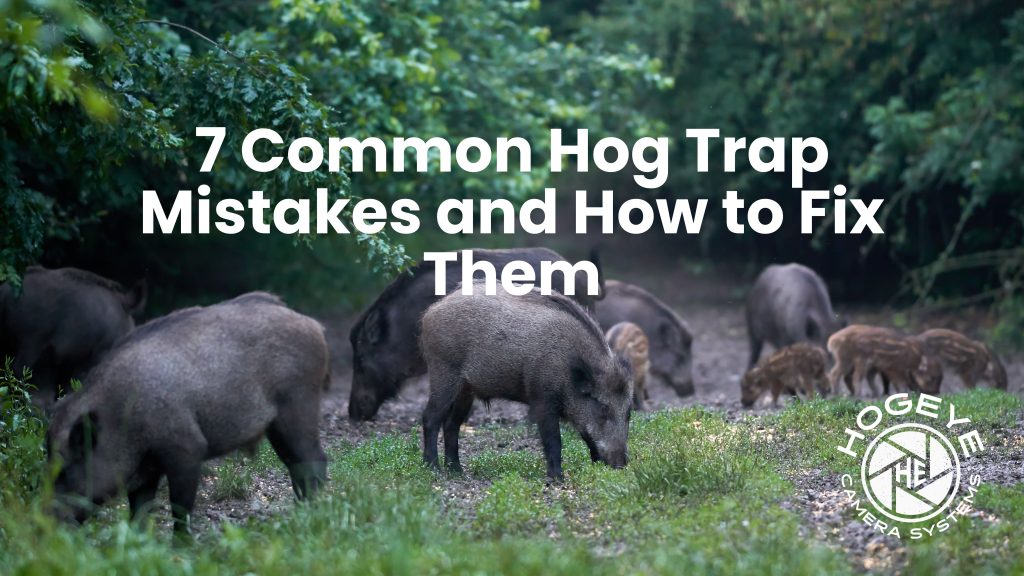
Most hog trappers aren’t failing because they’re using bad gear. They’re failing because their hog trapping techniques rely on timing, placement, and decisions made without enough information.
The seven mistakes below are the ones that consistently produce empty traps, spooked sounders, and wasted seasons. Some are obvious in hindsight. Several are counterintuitive. All of them are fixable, and most of them become much harder to make when you have real-time visibility into what’s happening at your sites.
Table of Contents (hog trapping techniques)
- Mistake 1: Placing the Trap Before Conditioning Is Complete
- Mistake 2: Checking the Trap on a Fixed Schedule
- Mistake 3: Closing on the First Hog Instead of the Whole Sounder
- Mistake 4: Using the Wrong Trigger Mechanism for Your Trap Type
- Mistake 5: Poor Trap Placement (Ignoring Sign and Travel Corridors)
- Mistake 6: Not Refreshing Bait at the Right Intervals
- Mistake 7: Running a Single Trap When the Problem Requires Multiple
- FAQ
This isn’t a beginner’s overview. If you’re already trapping and not getting results, this is where to look.
Mistake 1: Placing the Trap Before Conditioning Is Complete (hog trapping techniques)
This is the most common mistake and the one that does the most lasting damage.
Wild hogs are acutely sensitive to new objects in their environment. A trap introduced too early doesn’t just get ignored; it gets associated with danger. The sounder encounters the hardware, spooks, and learns to avoid the entire area. That association is durable. You can pull the trap, re-bait, and come back weeks later and still deal with a sounder that won’t commit.
The correct sequence in hog trapping techniques is simple: bait the site without hardware present. Run 7 to 14 days of pre-bait visits (deer corn, fermented corn, standing water, something that brings the sounder back consistently). Once they’re hitting the bait site confidently on consecutive nights, then you introduce the trap.
Signs you put the trap in too early:
– Hogs were hitting the bait site, then stopped completely after trap introduction
– You see single exploratory hogs at the edge of the trap perimeter, not entering
– Activity moved to a secondary location 200–400 yards away
A camera at the bait site during pre-bait phase tells you when confidence is actually there. Not when you assume it is. You can watch the sounder’s behavior shift from cautious to committed over multiple nights; and make the call to introduce hardware based on what you’re seeing, not a calendar estimate.
Mistake 2: Checking the Trap on a Fixed Schedule (hog trapping techniques)
If you’re driving out every morning at 7am to check the trap, you’re training the sounder to associate human activity with your site on a predictable schedule. Hogs pick up on this faster than most operators expect.
But the bigger problem is the missed window.
Hogs are predominantly nocturnal feeders. A sounder that commits to your trap at 2am and fills it by 2:30am needs to be closed at 2:30am. Not at 7am. By dawn, you may be looking at a spooked exit, a partial capture, or hogs that tested the trap and left. Every extra hour that trap sits open with an alerted sounder inside increases your chances of a bad outcome.
PAA: How often should I check my hog trap?
The honest answer is: as often as the situation demands, which means checking when something has happened, not on a fixed schedule. Checking an empty trap daily adds human scent, confirms nothing, and disrupts conditioning; checking a triggered trap at 2am closes the window when it matters.
There’s also a legal dimension most operators don’t account for. In Georgia, Game & Fish regulations require trapped animals to be removed within 24 hours of capture and traps to be monitored every 12 hours, regardless of what species ends up inside. Most states have comparable requirements. A fixed check schedule doesn’t satisfy that obligation; event-driven monitoring does.
The traditional approach (a standard trail camera checked on a schedule) compounds both problems. Trail cameras don’t send real-time alerts. You initiate the check, not the camera. High image volumes run up cellular data costs. And you’re still making schedule-based site visits, which add disturbance and don’t guarantee you’ll catch the closure window when it opens.
Remote monitoring removes the trade-off entirely. A real-time alert tells you when the sounder commits. You close the trap from your phone. No drive, no disturbance, no missed window. That’s not a convenience feature; it’s the difference between a successful capture and a trap-shy sounder that won’t return for weeks.
Mistake 3: Closing on the First Hog Instead of the Whole Sounder
This is a judgment error that turns a partial capture into a long-term problem.
If you’re running a box trap and you catch 2 of a 12-hog sounder, you haven’t solved anything. You’ve taught the other 10 that the trap is dangerous. Survivors associate the hardware with the loss of social members; and they become significantly harder to trap. Some won’t trap at all after this experience. Worse, those trap-shy animals breed. The next generation inherits a wariness of trap structures that’s embedded in the group’s behavior before they’ve ever encountered a trap themselves. A partial capture doesn’t just cost you this cycle. It can degrade a property’s trapping program across seasons.
The matriarch sow is the key target. She organizes the sounder’s movement and feeding patterns. If she escapes, the sounder reorganizes around her and picks up her wariness. Catch her, and the rest of the group is often less coordinated and more accessible in subsequent operations.
How do you know when the whole sounder is inside?
That’s the core problem. Checking a live feed from your phone, you can count heads before you close. A remote hog trap monitoring system lets you watch the sounder enter in real time, verify the count matches what you’ve been seeing at the bait site, and confirm the matriarch is in the group before you trigger. You’re not guessing based on what you think might be in there. You’re seeing it.
Closing on a partial sounder is almost always worse than waiting. The risk of doing it wrong compounds with every capture attempt.
Mistake 4: Using the Wrong Trigger Mechanism for Your Trap Type
Drop gates, swing gates, trip wires, net systems: each has a different false-positive profile.
A drop gate in a high-wind area can trigger without hogs. A trip wire calibrated for adult hogs may be walked through by boar pigs and won’t fire. A net trigger that’s too sensitive will deploy on a deer, spook whatever hogs are nearby, and leave you with a tangled net and no capture.
Common false-positive causes:
– Wind deflecting the trip plate or release pin
– Debris accumulation on the trigger mechanism
– Non-target animals (deer, raccoons, armadillos) activating trip wires
– Deterioration of the trigger calibration after rain or freeze
Calibration is a consistent maintenance task, not a one-time setup. Operators who treat the trigger as set-and-forget can accumulate false positives over time without realizing it.
A camera confirms whether a trigger event produced a capture or was a false positive, and which kind of false positive. That information tells you whether you need to recalibrate the sensitivity, adjust positioning, or clear debris. Without it, you’re re-setting the trap blind.
Mistake 5: Poor Trap Placement (Ignoring Sign and Travel Corridors)
Hogs move along defined routes. Rooting sign, tracks, and rub marks on fence posts or trees show you where they travel. The trap still needs to intercept how the sounder actually uses the property—but open clearings are often the right place for both the trap and the camera, not a compromise to avoid. Clearings buy visibility: you can read approach behavior, confirm what’s at the trigger, and close with fewer guesswork errors than a tucked-in setup where you never get a clean sight picture. The mistake is placing without tying the site to sign and travel pressure, not choosing a clearing when the clearing is where you can see and manage the event.
PAA: What is the best location to place hog traps?
The best placement still follows travel pressure: across a known corridor between bedding cover and a food or water source, with the entrance aligned so hogs encounter the trap naturally along their path. Within that logic, open clearings are often preferable for trap and camera placement because they support the field of view you need for remote monitoring and confident closures. Key considerations:
- Open clearings for visibility. Client guidance (Schell / ClearMark review): favor sites where cameras and operators can see the full approach and trigger zone rather than hiding gear in cover that looks “woodsy” but hides the decision you need to make.
- Water proximity in summer. Hogs need water daily in heat. Placing near reliable water sources dramatically increases traffic.
- Avoid flood zones. A trap in a low-lying area after rain is a flooded trap. Standing water inside the enclosure kills conditioning fast.
- Watch the escape route. Don’t place a trap against a fence or structure in a way that a spooked hog would pile into the perimeter while trying to exit.
- Soft ground problems. A gate that needs to drop cleanly shouldn’t be placed where the ground will shift, warp, or cause binding.
Sign-reading is the starting point. Understanding wild hog behavior (when they move, which routes they favor, how they respond to pressure) determines whether your placement is working with the sounder’s patterns or against them.
Mistake 6: Not Refreshing Bait at the Right Intervals
Two failure modes. Both common.
Too frequent: Every time you visit the site to refresh bait, you leave human scent. You disturb the area. If the sounder is in a sensitive conditioning phase, a disruption can push them off the site for days. Operators who are anxious about the bait going stale sometimes visit so often they break the conditioning they’ve been building.
Too infrequent: Hogs arrive at a site, find nothing, and move on. They’re opportunistic feeders. An empty bait site gets deprioritized. If you’re not refreshing often enough during the pre-bait phase, you lose the pattern you’re trying to establish.
The right interval depends on the sounder’s consumption rate, the bait type, and the weather. Fermented corn and deer corn hold up differently than fresh corn. High-traffic sites deplete faster than low-traffic ones.
A camera lets you monitor bait depletion without visiting the site. You can see when the pile is running low, time your refresh accordingly, and avoid unnecessary trips that contaminate the area with scent. That’s not a small efficiency gain; it’s the kind of operational discipline that separates successful conditioning runs from failed ones. For more on timing the full baiting sequence, see the hog trap baiting guide.
Mistake 7: Running a Single Trap When the Problem Requires Multiple
A box trap holds 2 to 4 hogs. A sounder of 15 cannot be addressed with one box trap, regardless of how well it’s placed and conditioned.
For large sounders, the right equipment is a corral or net system (something that can contain the full group in a single closure event). The Big Pig Traps corral system and Boar Blanket net trap are built for this specifically. One well-timed closure on a full sounder does more damage-control work than a dozen box trap captures over multiple weeks.
But large-sounder operations often require multiple trap sites running simultaneously, especially if the sounder is splitting across a property, or if you’re running a coordinated control effort across multiple parcels.
That creates a coordination problem. Driving between five active trap sites every morning adds hours to an already demanding operation. You miss closure windows. You add disturbance. You burn time on sites that are empty and miss the one that triggered at 3am.
Multi-site remote monitoring lets a single operator manage multiple locations without being on the property. Real-time alerts come to your phone. You see what’s happening at each site; you close the trap that matters when it matters, and you don’t touch the ones that don’t need attention.
The HogEye Steel Camera is built for this kind of field deployment (durable enough to run at remote sites, with reliable connectivity that doesn’t require you to be within range). Running multiple sites without the right monitoring infrastructure isn’t a scaling problem. It’s a losing strategy.
FAQ
What are common hog trap mistakes?
The most common hog trap mistakes are introducing the trap before conditioning is complete, checking on a fixed schedule instead of responding to real-time events, closing on a partial sounder, using a trigger mechanism that’s mis-calibrated for the site, placing without matching sign and travel corridors (or tucking traps and cameras where you cannot see the approach), refreshing bait too often or not often enough, and running one box trap when the sounder requires a corral or net system. Most of these mistakes share a root cause: operating without enough information about what’s actually happening at the site.
How often should I check my hog trap?
Check when something has happened, not on a fixed daily schedule. Daily checks add human scent and disruption to a conditioning site without producing useful information. A triggered trap needs attention as soon as possible after the closure event; an undisturbed site is better left alone. Remote monitoring allows event-driven responses instead of schedule-driven trips.
What is the best location to place hog traps?
The best location follows travel pressure: across a confirmed corridor between bedding cover and a food or water source, with the trap entrance aligned along the hogs’ existing path. Open clearings are often the best choice for both traps and cameras—you keep corridor logic, but you pick a site where you can actually see approach, occupancy, and trigger behavior (per client review). Still avoid flood-prone areas, soft ground that can cause gate binding, and layouts that put fence lines directly behind a likely escape route.
Why aren’t hogs going into my trap?
The most likely causes are premature trap introduction before conditioning is complete, bait that has gone stale or been depleted without replacement, a trigger mechanism that fired prematurely and taught the sounder the trap is dangerous, or placement that’s off the sounder’s actual travel route. A camera at the site will usually tell you which problem you’re dealing with within the first few nights.
Should I close the trap on the first hog or wait for the whole sounder?
Wait for the whole sounder, or as close to it as you can confirm. Closing on a partial group catches the easy targets and produces trap-shy survivors (often including the matriarch sow, who will reorganize the remaining hogs and make subsequent captures significantly harder). Count heads on a live camera view before you close.
Ready to stop making the mistakes that cost you captures?
HogEye gives you live visibility into your trap sites, real-time alerts when the sounder commits, and remote closure from your phone, so you close the right window, not the next available one.
Talk with the HogEye team about your operation →