
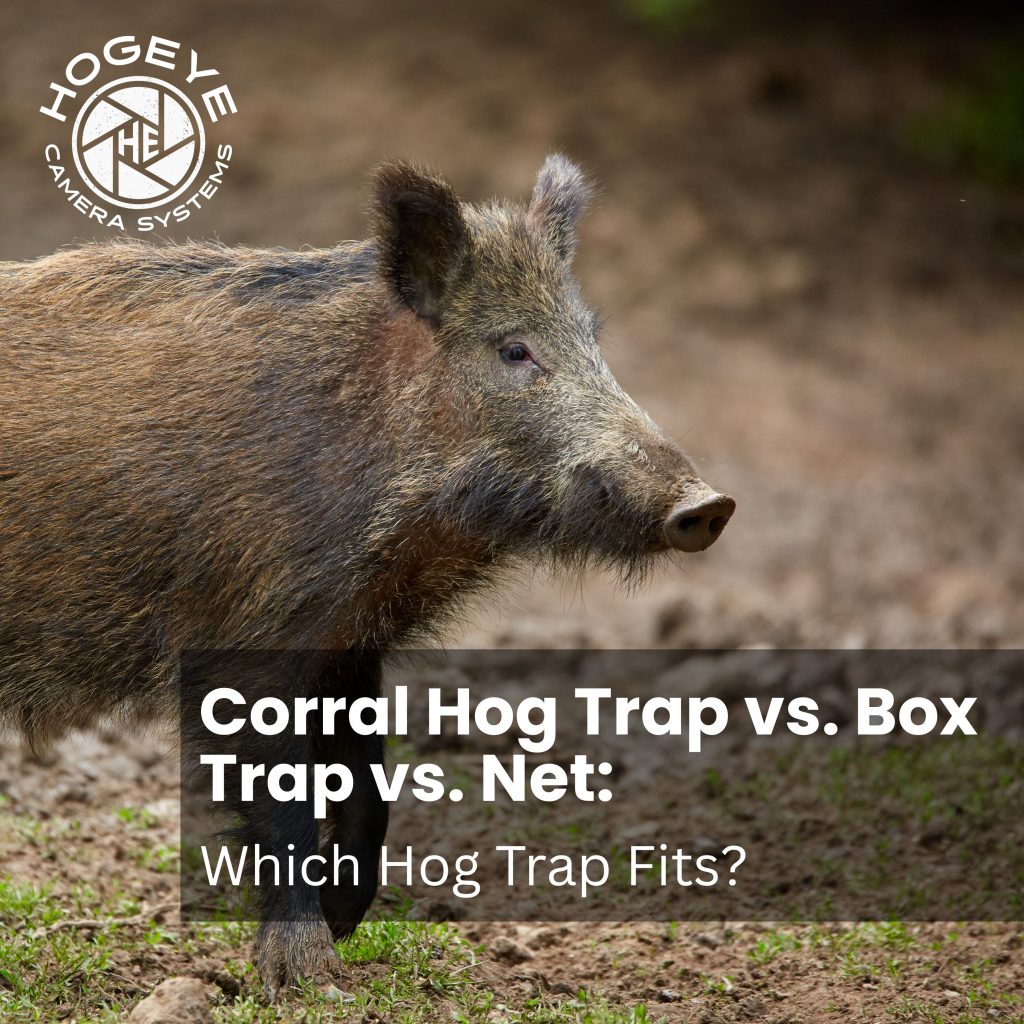
Choosing the wrong trap type is one of the most common and expensive mistakes in a hog management program. A box trap set against a sounder of 18 animals will catch one or two and educate the rest. A net trap lowered before the sounder is fully conditioned will be treated as a new obstacle; hogs won’t push under it, and you’ve reset your conditioning timeline. A corral hog trap set in a narrow brush corridor may never get the whole group inside.
If you’re deciding between a corral hog trap, a box trap, and a net drop net, the trap type has to match your property, your sounder size, and your operational capacity. This guide breaks down the three main hog trap categories, what each one is actually designed to do, and where each one falls short.
Table of Contents (corral hog trap)
- The Three Main Wild Hog Trap Categories
- Box Traps: Best for Solo Hogs and Small Groups
- Suspended Net Traps: Best for Smaller Sounders in Open Areas (Tree Sets in Forest)
- Corral Hog Trap (Panel Traps): Best for Catching the Whole Sounder
- Comparison Table
- How to Choose Based on Your Property and Sounder Size
- What All Three Trap Types Have in Common: The Monitoring Requirement
The Three Main Wild Hog Trap Categories (corral hog trap)
Most commercially available hog traps fall into three designs (roughly least expensive to most expensive in typical commercial setups):
- Box traps: fully enclosed metal boxes with a drop gate or spring door, sized for one to four animals
- Suspended net traps: nets raised above the bait site during conditioning, then lowered into position; hogs push under the net edge to enter, but the net geometry prevents exit
- Corral hog trap (also called panel traps): large circular or oval enclosures built from welded-wire livestock panels, hog panels, or purpose-built trap panels, with a gate triggered remotely or by a trip mechanism
Each design is built around a different capture scenario. Box traps are built for individuals and small groups. Net traps are built for whole-sounder capture on open or semi-open bait sites (with tree-set options in forest when hogs stay under canopy). Corral traps are built for sounders.
What all three have in common: they require conditioning (consistent bait placement over days or weeks before the trap is activated) and they require the operator to know when the right moment to close the trap has arrived. That second requirement is where most programs break down, regardless of trap type.
Box Traps: Best for Solo Hogs and Small Groups (corral hog trap)
How Box Traps Work (corral hog trap)
A box trap is a fully enclosed metal enclosure, typically 2–3 feet wide and 4–8 feet long, with a drop gate or spring-loaded door at one or both ends. The hog enters following bait, contacts a treadle plate or trip wire, and the gate drops.
Box traps are the most widely used hog trap in North America, primarily because they are cheap, portable, and require almost no setup. They are sold at most farm and feed stores and can be deployed by a single operator in under 20 minutes.
Capacity and Cost (corral hog trap)
Box trap capacity: 1–4 hogs in a single event. Larger box designs exist, but capacity is structurally limited by the enclosure dimensions.
Typical cost: $150–$600 for commercially available steel box traps. DIY wire crate designs can cost less.
What Box Traps Are Best For (corral hog trap)
- Nuisance singles or pairs
- Small groups of 2–4 animals
- Supplementary trapping alongside a corral or net program
- Properties with limited access or irregular terrain where panels cannot be transported
- Operators managing scattered low-density populations across a large area
The Core Limitation
A box trap cannot catch a sounder. If 14 hogs come to a bait site and a box trap is set, the operator catches one or two animals and the rest feed freely and are not pressured. The sounder learns the site is productive; the trap has done nothing to reduce population.
Box traps are a useful tool in specific contexts. They are not a hog control strategy on their own when a sounder is present.
Understanding common hog trap mistakes (including deploying a box trap against a large sounder) is essential before committing to any trap type.
Suspended Net Traps: Best for Smaller Sounders in Open Areas (Tree Sets in Forest)
How Net Traps Work
A suspended net trap works in two phases. During baiting and conditioning, the net is raised above the bait site so hogs can move freely in and out underneath it. This is intentional: the goal is to habituate the sounder to feeding in that location with the net present but not obstructing them.
Once the sounder is fully conditioned and hitting the site reliably, the trapper lowers the net into position around the bait area. The next time the sounder returns, they push under the bottom edge of the net to reach the bait, the same entry behavior they’ve been practicing. Once inside, the net geometry works against them. Hogs can push in but cannot figure out how to push back out the same way. The sounder is contained.
This mechanism captures animals from the perimeter rather than from above, which is why the conditioning phase is non-negotiable: the sounder must already be comfortable entering the space before the net is lowered.
Where nets fit geographically: Nets are strongest on open or semi-open bait sites—especially when the operator is targeting smaller to mid-size sounders that still need whole-sounder capture. In forested areas, a tree-set layout (anchors and rigging worked around standing timber) is an option when hogs will not commit to a wide-open bait but are already moving predictably under canopy.
Manufacturers in this category include Pig Brig, BoarBuster, and JAGER PRO, among others. Each has distinct rigging and release mechanisms. The Boar Blanket is HogEye’s soft net option, designed for compatibility with remote camera-triggered closure workflows.
Capacity and Cost
Many commercial net layouts comfortably hold about 20–30 hogs in a single event; with the right footprint and sounder behavior, roughly 20–40 hogs in one closure is realistic for some operators. Capture numbers depend on net size, site layout, and sounder behavior.
Typical cost: $2,000–$6,000+ for the net system itself. Most net buyers are individual landowners running a cost-effective program on their own ground—there is rarely a separate paid installation line item the way some corral builds use; time and labor go into learning the kit and staging it on-site. Dedicated monitoring hardware is not mandatory for every setup, but live video (even a simple phone-accessible feed) matters to cut unnecessary trips to the site and to read when the sounder is fully under the net. For large-sounder removal, nets are often a cost-effective way to take a whole group in one closure compared with scaling out multiple corral builds—when the terrain matches the system (open ground or a viable tree set in timber).
Durability: After multiple captures and sounder contact, mesh and rigging wear; budget for repairs and, eventually, replacement net material as part of the long-term cost of running a net program.
Setup Requirements
Net trap programs require:
- An open or semi-open site with adequate anchor points or frame installation—or a tree-set plan in forest when hogs stay under canopy. Tree sets can use trees as anchor points instead of long rows of T-posts and extra hardware, which saves time and gear and lets you put the trap where the hogs already are on the property.
- Training and careful rigging on the specific system: most net users are individuals; flexible fabric, cable, and frame parts reward a methodical first build (manufacturer videos, dealer walkthroughs, or mentor time with an experienced trapper).
- Dispatch and safe removal after a catch—important for any trap type. Feral hogs carry diseases; plan PPE, knives or dispatch tools, transport, and disposal the same way you would if you were part of a larger crew, even when working solo.
- Conditioning period equivalent to or longer than corral trap programs (14–21 days is common)
- Live video to time the drop and confirm the sounder is fully under the net—this reduces back-and-forth runs to the site; it does not have to mean an expensive separate “monitoring stack” beyond a camera feed you can check from your phone.
Net traps demand more rigging time and up-front cost than box traps, yet for many individual operators they stay an affordable route to whole-sounder removal—about 20–40 hogs in a strong closure is realistic when terrain and conditioning align. They are often cost-effective on a per-hog-removed basis for large sounders versus serial small-trap events. Plan for net wear over time (see Durability).
What Net Traps Are Best For
- Open fields and pastures where corral panels cannot practically fence the bait zone—especially smaller to mid-size sounders that still need whole-sounder removal
- Forested sites where a tree-set net mirrors how the group already travels and feeds under canopy
- Large-sounder programs where one high-count closure is worth the crew and equipment stack—nets stay an effective, cost-effective option in that lane when the footprint fits
- Individuals and smaller programs looking for a cost-effective way to manage hog populations on their own land
The Core Limitation
The trapper controls when the net is lowered into position; that decision requires knowing the sounder is fully conditioned and that the timing is right. After the net is down, the sounder’s next visit determines the capture. The operator still needs real-time visibility to confirm the sounder has entered and is fully contained before any dispatch or handling begins. A net lowered before conditioning is complete, or checked too late after entry, produces a failed program.
For net trap workflows specifically, the monitoring and timing requirements are the most demanding of any trap type. Live video is effectively required to close cleanly—but that can be a phone-accessible camera feed, not necessarily a separate monitoring hardware package.
Corral Hog Trap (Panel Traps): Best for Catching the Whole Sounder
How Corral Traps Work
A corral trap is a large circular or oval enclosure constructed from welded-wire livestock panels, hog panels, or purpose-built trap panels. Panels are staked into position around a baited center. The entry gate can be configured as a rooter gate (which hogs push open and cannot reverse), a trip-wire gate, or a remotely triggered electronic gate.
In practice that can mean a DIY build (posts and wire or panels you source locally), a livestock-panel layout with a triggered gate, or a commercial panel system. Big Pig Traps, for example, sells integrated Panel Trap kits (six panels and two gates per unit) sized for whole large sounders with more room around the bait than many small field-built circles.
The design principle is simple: make the enclosure large enough that hogs enter naturally, feed repeatedly without pressure, and eventually the full sounder is inside at once, at which point the gate closes.
What is a corral trap? A corral trap is a large circular or oval enclosure made from welded-wire livestock panels, hog panels, or purpose-built trap panels, used to capture entire sounders of feral hogs in a single closure event. Unlike a box trap (which targets one to four animals) a corral trap can hold ten to fifty or more hogs depending on panel count and configuration. The gate is typically triggered remotely or by a trip mechanism once the sounder is fully inside.
Capacity and Cost
Corral capacity depends on panel count and configuration. A standard setup using eight to twelve panels covers roughly 10–12 feet in diameter and handles sounders up to 10–15 animals comfortably. Larger setups using 16–24 panels can accommodate 30–50 hogs.
Cost depends on whether you’re building DIY or buying commercial.
DIY corral: T-posts, farm gauge wire fencing (e.g. Red Brand from Tractor Supply), a basic entry gate, and a standard deer camera runs $800–$2,500 in materials.
Commercial systems: Big Pig Traps are purpose-built for whole-sounder capture, not a DIY product. Drop trap starts at $4,499 (HogEye camera included). The Panel Trap (six panels and two gates per unit) starts at $5,695; that stock layout is about 25 ft in circumference and can comfortably hold 40+ hogs in typical field use, with price increasing for additional panels or gates. Commercial systems are more efficient and less time-consuming than DIY wire builds, and are designed to integrate with HogEye remote monitoring.
Setup Requirements
Corral traps require a flat or near-flat site with adequate soil for staking. Setup time runs two to four hours for an experienced operator. Trip-wire gates are lower-cost but require the operator to be present or nearby when the sounder enters. Remote-triggered electronic gates (the more effective option) allow closure from a distance without disturbing the site.
What Corral Traps Are Best For
- Sounders of 5–30 hogs
- Long-term management programs on the same property
- Operators willing to invest time in conditioning (10–14 days minimum)
- Sites with adequate space and vehicle access for panel transport
The Core Limitation
A corral trap only works if the gate closes when the entire sounder is inside. Close too early (before the dominant sow and older animals are in) and you catch the juveniles, educate the adults, and compromise the site.
Closing at the right moment is nearly impossible without real-time visibility into the enclosure. This is why corral traps and remote trap monitoring are inseparable in serious programs; operators need live video, not a check the next morning.
Comparison Table
Columns follow box → net → corral (roughly least to most expensive). Corral is split DIY (field-built wire/panel circles) vs commercial (integrated kits such as Big Pig Traps).
| Feature | Box Trap | Net Trap | Corral (DIY) | Corral (commercial) |
|---|---|---|---|---|
| Sounder capacity | 1–4 | ~20–40+ (layout-dependent) | ~10–30 common builds; 30–50+ large panel counts | ~40+ on a typical stock 6-panel + 2-gate kit; more with add-on panels/gates |
| Typical cost | $150–$600 | $2,000–$6,000+ | ~$800–$2,500 materials (wire, posts, gate, basic camera) | From ~$4,499 drop trap; from ~$5,695 6-panel + 2-gate panel trap (e.g. BPT) |
| Setup complexity | Low | High | Medium–high (more field fab) | Medium (integrated kit; less wire work) |
| Best sounder size | 1–4 hogs | Smaller–mid in open areas; tree sets in forest | 5–30 hogs on many properties | Large sounders when kit circumference matches the group |
| Remote closure | Sometimes | Yes (required) | Yes (with right gate) | Yes (with right gate) |
| Monitoring benefit | Helpful | Critical | Critical | Critical |
How to Choose Based on Your Property and Sounder Size
Use this as a starting framework (not a rigid rule) because every property and every sounder presents different variables.
Single nuisance hog or pair: Box trap. Low cost, fast deployment, adequate capacity. No reason to set a corral for one animal.
Sounder of 3–8 hogs: A box trap will catch one or two and leave the rest. For whole-sounder removal, choose a corral hog trap when you want steel/panel hardware you can run again and again on the same bait hub, or a net on open (or tree-set) ground when a lower upfront spend than a commercial corral matters more than decades of enclosure reuse.
Sounder of 8–20 hogs: Steel corrals—especially commercial kits with enough circumference—track larger sounders well and hold up to repeat captures across a season. Nets stay a cost-effective whole-sounder option on open or forest tree-set sites, commonly discussed for sounders in the ~15–25 hog range and similar mid-size work. Running multiple corral traps on the same property is often more practical than one oversized net deployment.
Sounder of 20+ hogs: Prioritize commercial corral thinking—expanded steel panel counts—when very large sounders and serial pressure mean hardware must not tear. A net can still clear a big group in one night when terrain, conditioning, and crew line up—just budget mesh wear against a $5,000+ class steel investment.
Budget vs. catch-rate tradeoffs: A $200 box trap may catch one hog per event; a ~$2,199 class net or a $5,000+ corral trap can remove an entire sounder in a single night when the closure is timed right. The math on cost per hog removed still favors stepping up from a box when a whole sounder is on the line.
Running multiple trap types simultaneously is common in serious programs. Corral traps—particularly steel commercial systems—excel for larger sounders and for tapping the same property over time because panels and gates outlast fabric. Net traps are a strong cost-effective fit for smaller whole-sounder scenarios—often in the ~15–25 hog conversation on open or tree-set sites—knowing nets wear and need repairs or replacement. Box traps at secondary bait sites still pick off stragglers. The tools are not mutually exclusive; they serve different functions across the same property.
Wild hog behavior and trap timing data affects all three approaches. Understanding movement patterns, feeding windows, and sounder composition before setting any trap increases closure success across the board.
What All Three Trap Types Have in Common: The Monitoring Requirement
The biggest variable in any trap program is not the trap; it is the operator’s ability to know what is happening at the trap site in real time.
The monitoring story below follows box → net → corral—the same sequence used for pricing and categories earlier—so you can compare how each trap type consumes operator attention.
Box traps: Monitoring is less critical here (the trap closes on contact) but there is still value. Knowing when a catch has occurred allows the operator to dispatch quickly, before a trapped hog causes injury to itself or other animals that may be present. Checking a box trap 12 hours after capture is common and largely avoidable.
Net traps: Triggering too early or too late does not just miss the event; it educates the sounder. A spooked sounder under a prematurely triggered net may abandon the site entirely. Real-time video is the only reliable way to read when the moment is right.
Corral traps: The gate cannot close itself at the right moment. A trip-wire gate closes on the first animal that contacts it (often before the sounder is fully inside). A remote-triggered gate only closes when the operator decides to close it. That decision requires visibility.
There is also a legal dimension that applies across all three trap types. In Georgia, regulations require trapped animals to be removed within 24 hours of capture and traps to be monitored every 12 hours. Similar requirements exist in most states. This applies to any animal that enters the trap, not just hogs. A schedule-based checking model may not satisfy that obligation; real-time monitoring does. You know when a trap triggers, you respond, and you stay within the legal window without unnecessary drives to empty sites.
A wild hog trap camera system integrates with any of these trap types. It provides live video, motion-triggered alerts, and (on corral and net systems with compatible gates) remote closure from a phone. The camera does not choose the trap type; it makes whichever trap you are running more effective by giving the operator the information needed to close the trap at the right time.
This is the gap that standard motion-triggered cameras cannot fill. A purpose-built hog trapping camera delivers live video, not a historical still image from 45 minutes ago. When the closure window is open, the operator needs to see what’s happening now… not what happened while they were asleep.
Frequently Asked Questions
What is the most effective hog trap?
There is no single most effective trap; outcome depends on sounder size, terrain, and how long you plan to run the same bait hub. Box traps are effective only for individual hogs or pairs. Net traps are easy to move and can take a single hog or multiple larger sounders (25+ hogs) when the footprint and conditioning line up. Corral traps produce the best results if your feral hog problem is larger and you need a longer-term solution; most corrals can handle sounders of 40 hogs or more, depending on circumference and panel layout. The trap type should match the target scenario on your land.
What is a corral trap for hogs?
A corral trap is a large circular or oval enclosure built from welded-wire livestock panels, hog panels, or purpose-built trap panels, staked around a bait site to capture entire sounders of feral hogs. A gate (trip-wire, rooter-style, or remotely triggered) closes once the sounder is inside. Corral traps can handle sounders of ten to fifty or more animals depending on panel count and enclosure size.
How large of a sounder can a box trap catch?
A box trap is designed to catch one to four hogs per event, constrained by the physical dimensions of the enclosure. It cannot catch a sounder. If a sounder of ten or more animals is using a bait site, a box trap will capture one or two animals while the remaining animals feed freely and are not pressured. A corral or net trap is required to address a sounder.
What are the disadvantages of hog traps?
Each trap type has specific limitations. Box traps cannot catch sounders. Corral traps require flat terrain, vehicle access, and significant setup time. Net traps use fabric that wears; they reward training on flexible rigging and a clear dispatch plan. All trap types require conditioning periods of ten days or more before closure, and all require the operator to know when the sounder is present and positioned, which is difficult or impossible without remote monitoring. Traps that close at the wrong moment educate the sounder and can compromise the site for weeks.
Do I need a camera to use a hog trap?
You do not need a camera to operate a box trap triggered by a treadle plate. For corral traps with remote gates and for all net trap systems, a remote monitoring camera is effectively required for consistent results. The closure window (the moment when the full sounder is inside the trap) is brief and unpredictable. Without real-time visibility, operators either miss it or close too early; either outcome degrades program effectiveness.
Ready to add remote monitoring to your trap program, whatever trap you’re running?
HogEye integrates with corral traps, net systems, and box trap programs. Live video, real-time alerts, and remote closure from your phone.
Talk with the HogEye team about your operation →