
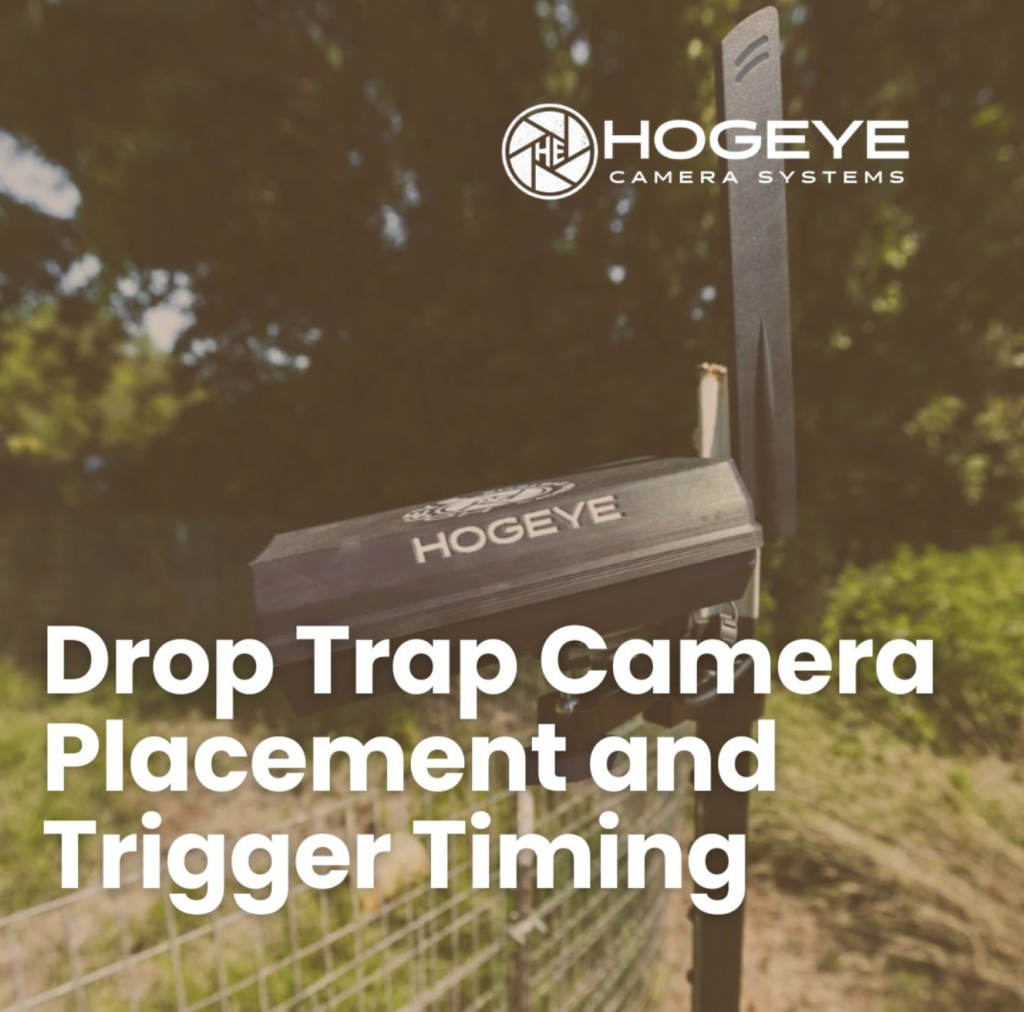
A drop trap only pays when the whole sounder is under the trap at the moment you send the closure command. Camera placement and trigger timing are the two decisions that make or break that outcome. Get either one wrong and you catch the bold hogs, educate the rest, and spend weeks rebuilding trust at the site.
If you run a drop-style system, camera placement and trigger timing decide whether you remove a sounder or educate it. The focus here is monitoring and closure quality. For commercial drop and panel hardware context, including Big Pig systems, use the hog traps page.
What the Camera Must Show on a Drop Trap
On a drop trap, the feed has to answer a harder question than “are hogs here?” It has to show whether the sounder is committed under the trap before you drop.
Aim for a frame that covers:
- Inside the drop zone so you can count hogs that are truly under the trap
- The approach and edges so you can see hangers, late arrivals, and animals still outside
- Enough depth at night that IR or live view still lets you separate committed hogs from shadows at the margin
If the camera only sees the bait pile and misses the edge, you will trigger too early. If it only sees the approach and misses the center, you will hesitate when the sounder is already in.
Placement Rules That Protect the Decision
- Mount for the trap geometry, not the prettiest tree. Height and angle should keep the full drop footprint readable.
- Keep the lens out of the drop path and hog traffic abuse as much as practical while preserving the frame.
- Confirm day and night views before you trust the site. A daytime install can hide night glare, washout, or blind corners.
- Protect the cellular or connection path without sacrificing trap coverage. A silent camera at the perfect angle still loses the window.
- Name the site clearly in the app if you run multiple traps so the right closure command goes to the right drop.
A purpose-built HogEye steel camera setup is built for that trap-site job. Use camera resources for install references while you lock the standard for your team. Soft-net drop workflows are adjacent but different; see net camera trap remote hog trapping when that is your hardware.
Conditioning First, Then Catch Phase
Drop timing quality starts before you ever send a closure command.
- Keep bait consistent so the sounder patterns to the site over multiple nights.
- Watch whether the same animals return and whether the count grows toward a full sounder.
- Do not rush catch phase because one or two bold hogs look easy.
Commercial drop systems such as Big Pig drop traps are built for whole-sounder capture and are designed to integrate with HogEye remote monitoring. A drop trap system starts at $4,499 with the HogEye camera included. That investment only returns if conditioning discipline and camera reads stay honest.
Trigger Timing: Close When the Sounder Is Under
Use the live feed to wait for commitment, not excitement:
- Do not trigger while hogs are still entering, circling, or feeding only at the edge.
- Do trigger when the full sounder you have been counting is under the trap and settled.
- Prefer remote closure at the real window, including middle-of-the-night windows, instead of waiting for a convenient drive.
Partial captures are not small wins. Survivors associate the structure with danger and become harder to catch. The camera earns its keep by letting you wait for the whole sounder.
Quick Pre-Drop Readiness Check
Before you arm a catch window, confirm:
- Camera reports and the night view is readable
- Trap mechanism is set for catch phase
- Bait is holding
- Recent nights give you a sounder count you trust
- Your team knows who is authorized to send the closure command
If any item fails, stay in watch mode. A dropped trap on bad information costs more than another night of conditioning.
When you are ready to match camera and trap hardware, compare pricing and options.
Frequently Asked Questions
Where should I place a camera on a drop trap?
Place it so you can see the full drop footprint and the edges at the same time. You need to count committed hogs under the trap and spot animals still outside before you send the closure command.
When should I trigger a drop trap?
Trigger when the full sounder is under the trap and settled. Do not close on the first hogs through or on animals still working the edge.
Why does early triggering hurt so much on drop traps?
Partial captures educate survivors. Those hogs become trap-shy and can set the site back for a long time.
Do I need a purpose-built trap camera for a drop trap?
You need a system that supports live trap decisions and remote closure, not only after-the-fact pictures. That is the job a wild hog trap camera system is built for.
How do Big Pig drop traps fit this workflow?
Big Pig drop systems are commercial whole-sounder traps designed to integrate with HogEye remote monitoring. A drop trap system starts at $4,499 with the HogEye camera included.
Ready to Time the Drop With a Real Read?
HogEye puts live eyes on the drop zone so you close when the full sounder is under the trap, not when the first hogs look tempting.
Talk with the HogEye team about camera placement on your drop trap →