
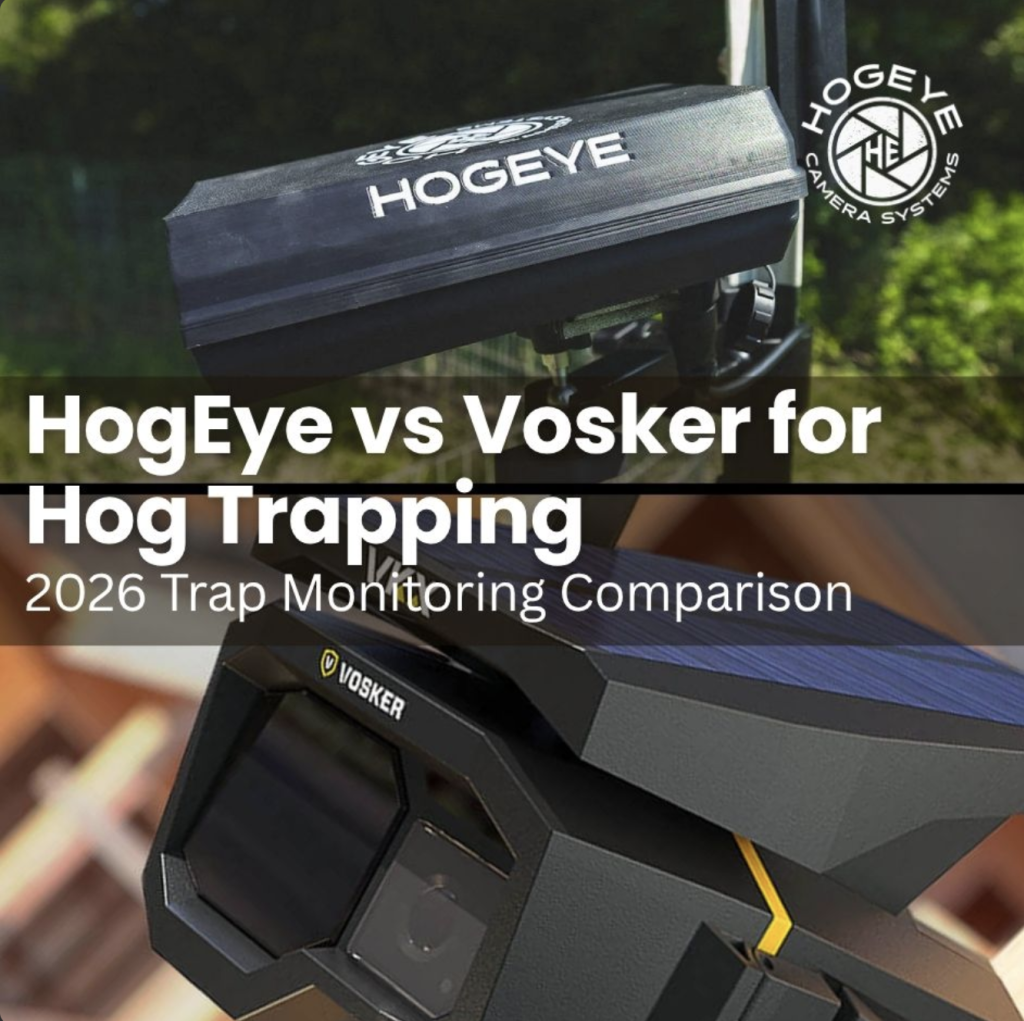
HogEye vs Vosker hog trapping in 2026 turns on one practical question: are you trying to document activity, or close a trap at the right moment? A camera that tells you hogs were there last night can help with scouting. A primary trap site needs more. It needs a live view of the trap, a clear count of the sounder, and a reliable way to send the closure command.
Define the Trap-Site Job
Observation asks what moved through. Trapping asks whether the complete sounder is committed inside the trap zone right now. Those are not the same job, and treating them the same is how teams end up with educated hogs and long setbacks.
A general cellular camera can help confirm fresh use of a crossing, bait site, or travel route. Once the trap is set for catch phase, delayed information becomes less useful. The operator needs to see the entry, the trap interior, and enough of the approach to know what is still outside.
Where Vosker Fits
Vosker makes capable solar cellular cameras for general observation. That can be a good fit when you are learning a new site, watching a secondary bait station, or working a location where no remote closure command will be sent.
- Useful for scouting and visitation records
- Practical on secondary sites
- Appropriate when delayed information fits the plan
The tradeoff matters. Observation-first hardware may show that hogs visited, but it does not automatically give the team a live sounder read or a trap-native closure path. On a catch-phase trap, that gap can turn into a partial capture.
Where HogEye Fits
HogEye is a wild hog trap camera system built around remote trap monitoring and closure. The point is not another photo gallery. The point is decision quality when the sounder is feeding, the gate or trap is ready, and the operator has one clean chance.
- Live view for counting hogs before closure
- Remote trigger path tied to the trap operation
- Trap-site hardware built for panels, actuators, and hog contact
- Trapping-specific support for conditioning and catch phase
The HogEye Steel Camera supports primary trap-site monitoring for corral and gate workflows. HogEye Mini is $1,299 with $49.99 monthly data on AT&T or Verizon, with no contract. Commercial drop and panel packages on the hog traps page start at $4,499 with HogEye included.
Choose by Workflow
A general observation camera can be used for site scouting or as a secondary trap monitor. In contrast, the HogEye system is a dedicated wild hog trap camera system. It continuously monitors your trap site, enabling remote closure at the optimal moment, and allows you to monitor and trigger traps at multiple locations.
Neither choice fixes weak bait discipline, poor conditioning, or a vague closure rule. Wait until the full sounder is inside and confirm the hogs have settled. Closing on the first few animals teaches the rest, a lesson that can last for months.
Cost the Decision, Not Just the Camera
The lowest receipt is not always the lowest operating cost. Count the drive to an empty trap, the missed 2 a.m. closure window, and the damage from a sounder that learns the setup. A lower-cost observation unit can be right for a scout site. The primary catch site deserves enough live information to close the complete group.
Mixed Lines Can Work
Some operators run general cellular cameras on scout crossings and HogEye on the trap that will actually close. That is a sensible site-by-site plan. You do not have to replace every camera at once. Keep the closure decision on the fastest, trap-native feed.
Before catch phase, test cell coverage from the final mount, confirm night visibility, name each site clearly, and frame both inside and outside the trap. The camera resources library covers placement and setup. When a scout site becomes a catch site, compare pricing and options.
Frequently Asked Questions
Is HogEye better than Vosker for hog trapping?
For live sounder reads and remote closure on a catch-phase trap, HogEye is the purpose-built choice. Vosker can fit general observation.
Can I use Vosker on a corral trap?
Yes, for activity photos and visitation records. The limitation is latency when the full sounder enters after the last image.
Should I run both?
Some teams do. Use observation cameras for scouting, then keep the primary closure decision on a live, trap-native feed.
Buy for the Catch
HogEye vs Vosker hog trapping is not about owning the most cameras. Match observation to scout sites and live remote trap monitoring to the site where closure timing determines the outcome.