
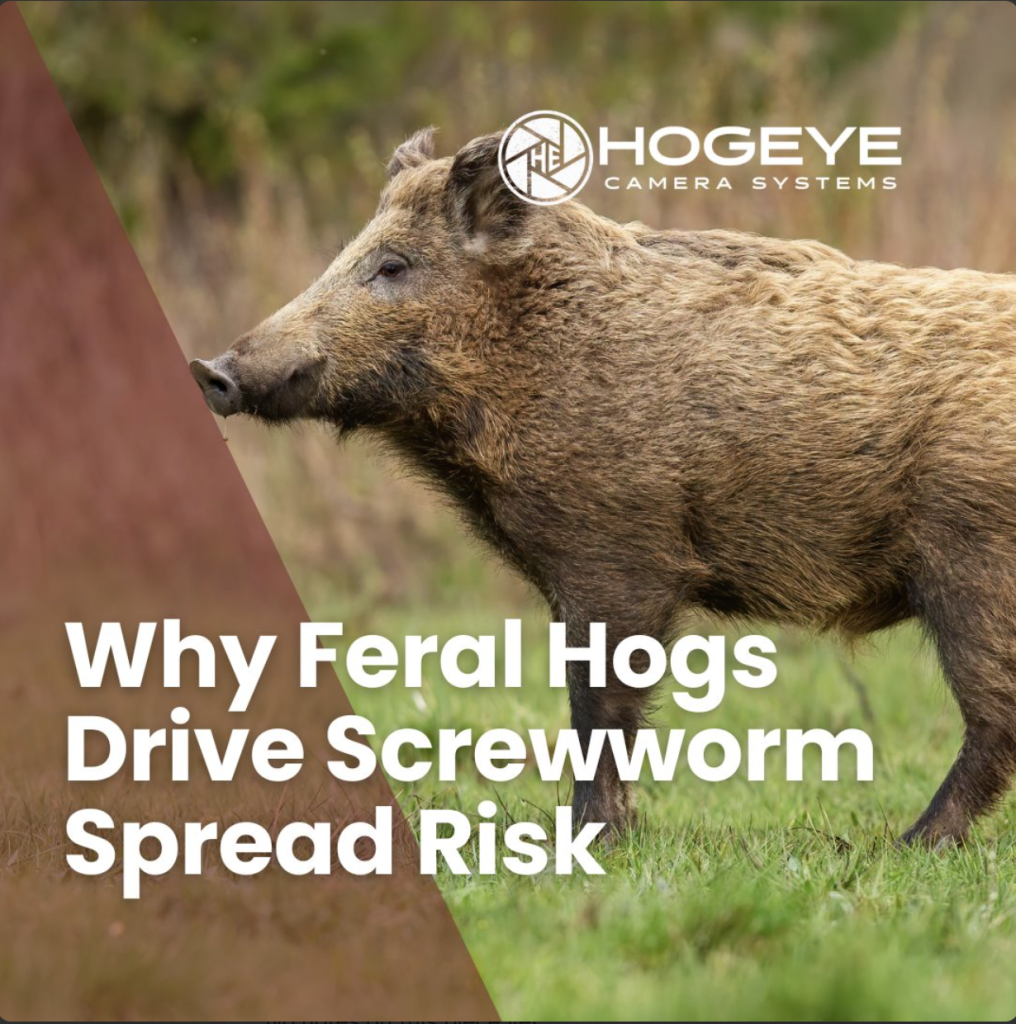
When people talk about screwworm risk, the conversation almost always starts with cattle. That makes sense, because cattle are valuable, visible, and inspected. But the animals most likely to move a wound-seeking parasite across a region are not the ones standing in the pen. They are the feral hogs nobody is checking.
This guide explains why feral hogs are the hardest host to control when New World screwworm pressure rises, and what that means for how landowners and trappers in Texas and the Gulf South think about coverage. For clinical and reporting guidance, the authorities are USDA APHIS and your state agricultural extension office. This is an operations and awareness piece, not a treatment manual.
First, the One Fact That Reframes the Problem
New World screwworm breeds on live animals, and occasionally very recently deceased ones, never in waste. Per USDA APHIS, the fly lays eggs at the margin of a fresh wound on a warm-blooded host, and the larvae feed on living tissue. The blunt field rule is worth repeating: if it’s on shit, that isn’t it.
That single fact is why the host animal matters more than the location. You are not trying to keep a parasite out of a manure pile or a carcass. You are trying to account for every living, wounded, warm-blooded animal moving across your ground. Most operations have a handle on the cattle. Almost none have a handle on the hogs.
Hogs Move Faster and Farther Than the Animals You Watch
A penned or pastured herd stays where you put it. A sounder of feral hogs does not. Feral hogs commonly range up to roughly six miles in a single day, crossing fence lines, water, and neighboring properties on a schedule you do not set.
That mobility is the core of the threat. A host that travels miles a day does three things a stationary animal cannot:
- It carries any infestation to new ground before you would ever notice.
- It connects properties that otherwise have nothing to do with each other.
- It arrives at shared water and feed long before daylight, when no one is looking.
In a parasite that spreads with its hosts, the fastest, widest-ranging host sets the pace. On most land in hog country, that is the feral hog.
Hogs Are Constantly Wounded, and They Attract Flies
Screwworm needs a wound. Feral hogs supply them constantly. Boars fight, sounders push through brush and barbed wire, and rooting and wallowing leave animals scraped and cut as a matter of routine. A population of wide-ranging animals with fresh wounds is exactly the entry point the parasite looks for.
Feral hogs also attract flies. Their habits, their wallows, and their wounds make them a magnet for the kind of insect activity that a wound-seeking fly thrives in. You do not have to assume every hog is infested to see the problem: you have a mobile, fly-attracting, frequently injured population that no one inspects.
The Real Gap Is Visibility, Not Cattle
Here is the uncomfortable part. A cattle operation can do everything right, inspect the herd, treat fresh wounds, watch closely during high-risk work, and still sit next to a completely blind population of wildlife and feral hogs using the same ground. The weak point in the system is not the watched animals. It is the unwatched ones.
That is the difference between livestock and wildlife in a screwworm season. You can put eyes on cattle. You cannot put eyes on every hog, deer, or other animal crossing the back forty at 3 a.m. The result is a large, mobile, high-risk host population operating with zero observation, right alongside the herd you are protecting.
What You Can Actually Do About the Hog Side
You cannot inspect a wild sounder, and you should never try to diagnose screwworm from a distance. What you can do is stop treating feral hogs as invisible. Knowing which sounders use your property, where they cross, and how often they return is the first step to managing the part of the risk you have been leaving blind.
Two things move the needle:
- Run an active trapping program. Removing whole sounders reduces the number of wide-ranging, wound-prone hosts on your ground. Whole-sounder removal, not picking off one or two, is what actually lowers the population.
- Put eyes on your trap sites remotely. A remote hog trap monitoring system tells you when hogs are working a site and when a sounder is committed, so you trap on real activity instead of guesswork. That same awareness is what turns “unmonitored wildlife” into a population you can finally account for.
For trap-line setup and placement references, the camera resources library walks through the basics. And if you ever suspect screwworm in any animal, contact USDA APHIS and your state extension office first. Reporting is the job, not treatment.
Frequently Asked Questions
Why are feral hogs worse than cattle for screwworm spread?
Cattle are inspected, treated, and watched. Feral hogs are wide-ranging, frequently wounded, and unmonitored, so they can carry and move the risk across properties without anyone seeing it.
How far do feral hogs travel in a day?
Feral hogs commonly range up to roughly six miles in a single day, which lets a single sounder connect properties and move a problem to new ground quickly.
Do feral hogs cause screwworm?
No. Screwworm is caused by a parasitic fly. Feral hogs do not cause it, but they are an effective mobile host because they travel widely, get wounded often, and attract flies.
Can I tell if a hog has screwworm from a camera?
No. Cameras tell you where hogs are active and when they move, not whether an animal is infested. Diagnosis and reporting are the role of USDA APHIS and your state extension office.
What is the single most useful thing a landowner can do?
Reduce the unwatched host population and stop being blind to it: run a whole-sounder trapping program and monitor your trap sites so you know what is actually moving through your property.
Ready to Stop Leaving the Hog Side Blind?
HogEye puts live eyes on your trap sites so you know which sounders are using your ground and when, the population most operations never see.
Talk with the HogEye team about monitoring your trap sites →